Mobility vs. Flexibility
Why You Can Be Flexible and Still Feel Stiff
In this post:
Flexibility is a part of mobility – they are not interchangeable concepts
Why movement builds in layers — and why your joint, not your muscle, sets the ceiling
Why your brain sometimes blocks movement you're flexible enough to make
What actually closes that gap
Why Pilates trains exactly what's missing
You can touch your toes and still feel like your hips are made of concrete. You can do splits and still throw your back out picking up a bag. If that sounds contradictory, it's because most people use one word — flexibility — to describe two entirely different capacities.
Flexibility and mobility get used interchangeably — but they are not the same capacity. Most people respond to stiffness by adding more stretching, but that's often solving the wrong problem entirely. Understanding the difference changes how you should be training, and it explains why years of stretching haven't necessarily made you move any better.
The Basic Difference
Flexibility is the ability of a muscle or muscle group to lengthen passively through a range of motion.
It relies on the elasticity of your muscles, tendons, and ligaments — whether you're easing into a stretch on your own, holding a pose in a yoga class, or a teacher deepens it for you.
Either way, the muscle isn't doing active work to get there, it's simply allowing itself to lengthen.
Mobility is the ability of a joint to move actively through a full, controlled range of motion.
It draws on flexibility, but adds strength, core stability, and neuromuscular control — and this time, you're doing the work yourself.
Lifting your own leg high and holding it there, no hands, no assistance, is mobility.
Mobility encompasses flexibility, range of motion, strength, coordination, motor control, and balance. Flexibility is a component of mobility, not a synonym for it — you can have the component without the whole.
How Mobility and Flexibility Fit Together
Mobility is essential for daily living — sitting, standing, walking, bending down to pick something up. Poor mobility doesn't just limit performance, it raises injury risk in ordinary daily movement, and for athletes, moving freely and without pain translates directly into better performance.
Flexibility fits directly into this. It lets everyday tasks happen efficiently and without strain, supports good posture, and through better circulation helps deliver oxygenated blood to muscles for improved output and faster recovery. Flexibility is an important component that allows mobility to build.
Understanding the Biomechanical Hierarchy
Movement doesn't happen all at once, it builds in layers, and each layer depends on the one below it.
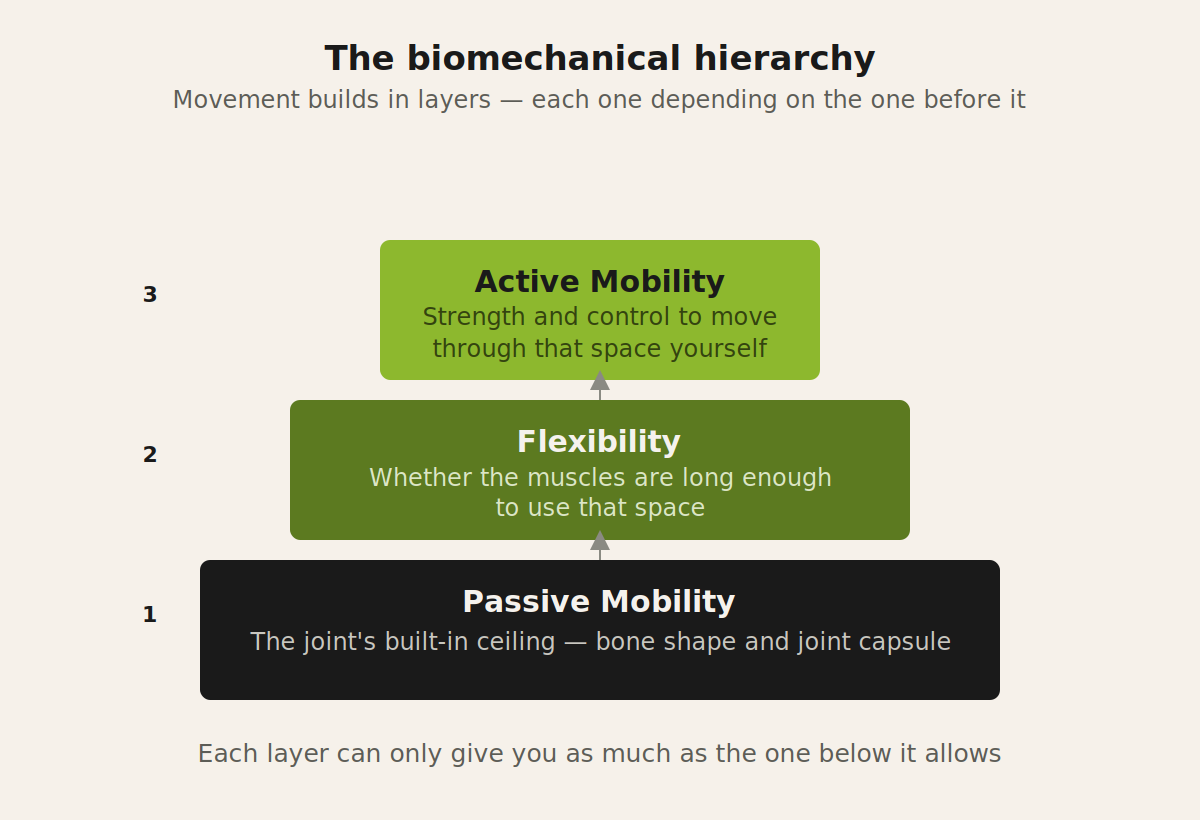
First is the base structure — your joint — which itself has a built-in ceiling, set by bone shape and the tissue around the joint. This foundation sets the range available for mobility; no amount of stretching can change that.
Second — your muscles — they need to be long enough, and have the flexibility, to actually use the space available within the joint.
And third, your body needs the strength and neurological control to move through that space on its own, not just get pushed into it by someone or something else.
Each layer can only give you as much as the one below it allows — that's why you can have all the room your joint allows, and all the length your muscles allow, and still not be able to use either one on your own. So, what's actually needed to close that gap?
The Brain's Safety Brake
Active mobility — your range of motion and how well you can actually move — isn't determined just by your joint structure and muscle flexibility. Inside your muscles and tendons are sensory receptors that constantly monitor stretch.
If your brain senses that you don't have the strength to stabilize and control the joint at the end-range - the farthest point it can stretch or bend to - your nervous system applies a protective “brake" — limiting active mobility to the range it can safely control.
So it isn't that your muscle lacks the flexibility to reach the extreme end-range — the brain is signaling a lack of motor control and muscle strength to work safely there. Approaching the limit of your active range, your muscle can start to jitter, shake, or push back against you, often leading to an urge to back off. Stretching more is not the solution here.
How to Actually Lift the Brake
You need to strengthen the muscle and build better motor control — to convince the brain the end-range position is safe for you to work in.
Building strength at a muscle's end range helps overcome the brain's fear of getting stuck or collapsing.
Training deep stabilizing muscles keeps the joint centered and moving smoothly.
Building motor control refines coordination between opposing muscles across a joint.
These three things — end-range strength, joint stability, and coordinated muscle control — are exactly what Pilates is built to train.
Where Pilates Fits Into This
Pilates trains all three of these directly. Movement through end-range and eccentric control builds exactly the kind of strength the first mechanism calls for. The constant focus on alignment and centering builds the joint stability the second requires. And the sequenced, opposing-muscle work built into every exercise trains the coordination the third depends on.
This combination of range plus control is the working definition of mobility — and the foundation of all Pilates movements.
This is why clients who come to me already flexible — dancers, yoga practitioners, people who've stretched for years — are often surprised by how much Pilates changes the way their body feels and moves. The range was already there. What was missing was the strength and control to use it.
The Real Takeaway
If you've been stretching for years and still feel stiff, more stretching usually isn't the answer. The range is often already there — what's missing is the strength and control to convince your body it's safe to use it. That's the real gap between flexibility and mobility, and closing it is what actually changes how you move, not just how far you can be pushed.
Stretching alone won't translate into strong, efficient movement or less stiffness. Pilates was built to address exactly that. If you'd like to know more, get in touch.
Related reading:
What “Functional Fitness" Actually Means for Daily Life
Beyond Spot Reduction: The Real Way to Reshape Your Body